

If you are preparing to file bankruptcy in Georgia, completing a bankruptcy credit counseling course is one of the required steps for most individual filers. The course must generally be completed before your bankruptcy case is filed, and a separate debtor education course is generally required after filing before you can receive a discharge.
For people considering Chapter 7 or Chapter 13, these courses can sound like another complicated part of bankruptcy. In practice, they are usually straightforward. The important part is knowing which course you need, when to take it, and whether the provider is approved.
Attorney expertise: Reviewed for CMC Law, founded by Atlanta bankruptcy attorney Charles M. Clapp, whose practice focuses on Chapter 7 and Chapter 13 bankruptcy for consumers and small businesses in Georgia.
Bankruptcy Credit Counseling Course
- What is it? Pre-bankruptcy credit counseling is a financial review that covers your budget, debts, and possible alternatives before you file.
- When do you take it? Most individual filers must complete the course within the 180-day period before filing bankruptcy.
- Who can provide it? The course generally must come from a credit counseling agency approved by the U.S. Trustee Program.
- Is there another course after filing? Yes. Most individual filers must also complete a separate personal financial management course, commonly called debtor education, after filing and before receiving a discharge.
- Does this apply to Chapter 7 and Chapter 13? Yes. Individual Chapter 7 and Chapter 13 filers generally must satisfy the pre-filing credit counseling requirement.
- What if you skip the first course? Filing without satisfying the pre-filing requirement can put your eligibility at risk and may result in dismissal of the case unless a valid exception applies.
What Is a Bankruptcy Credit Counseling Course?
A bankruptcy credit counseling course is a required pre-filing financial counseling session for most individuals seeking bankruptcy relief. Its purpose is to review your financial situation before the bankruptcy petition is filed.
Federal law generally requires an individual debtor to receive a briefing from an approved nonprofit budget and credit counseling agency during the 180-day period ending on the filing date. The briefing covers available credit counseling opportunities and includes a related budget analysis.
The course does not decide whether you are “allowed” to file Chapter 7 or Chapter 13. It is also different from the Chapter 7 means test, which is used as part of determining Chapter 7 eligibility.
During pre bankruptcy credit counseling, you can generally expect to review information such as:
- Your income
- Regular household expenses
- Secured and unsecured debts
- Your monthly budget
- Possible ways of addressing your debts
- Whether a debt management plan is available
Completing the counseling does not mean you have agreed to a repayment plan or given up your ability to file bankruptcy.
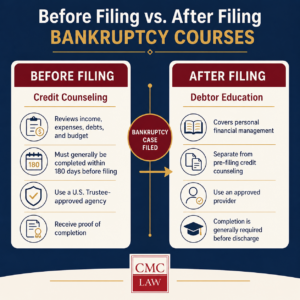
Credit Counseling Before Filing vs. Debtor Education After Filing
Bankruptcy involves two different financial education requirements for many individual filers. They are not interchangeable and cannot simply be completed together as one course.
When Do You Have to Take the Pre Bankruptcy Credit Counseling Course?
Most individual bankruptcy filers must receive the required credit counseling during the 180-day period ending on the date the bankruptcy petition is filed.
This timing matters.
Taking the course too early can create a problem because the counseling may fall outside the permitted 180-day period. Filing first and planning to complete ordinary credit counseling afterward can also create a serious eligibility problem unless a statutory exception or temporary waiver applies.
For that reason, do not treat the counseling certificate as a minor piece of paperwork. Coordinate the course timing with your bankruptcy attorney, especially if there is a reason your case may need to be filed quickly.
How Do You Find an Approved Bankruptcy Credit Counseling Provider?
For a bankruptcy filing, choosing a general financial counselor is not enough. The provider generally must be approved to provide bankruptcy credit counseling by the U.S. Trustee Program.
The U.S. Trustee Program maintains lists of approved organizations for both pre-filing credit counseling and post-filing debtor education.
You can begin with the U.S. Trustee Program Credit Counseling and Debtor Education Information.
When selecting a provider, confirm that:
- The organization appears on the appropriate approved-provider list.
- You are enrolling in credit counseling if you have not filed yet.
- You are enrolling in debtor education or personal financial management if your case has already been filed.
- The provider can issue the appropriate proof of completion.
- You understand how your certificate or completion notice will reach the bankruptcy court or your attorney.
Do not assume that a company offering general debt counseling automatically qualifies to provide the bankruptcy course.
What Happens During Credit Counseling for Bankruptcy?
The credit counseling course for bankruptcy is designed to give you a structured look at your financial situation.
The required briefing includes a discussion of available credit counseling opportunities and assistance with a related budget analysis.
You may be asked to provide estimates or information about your income, household expenses, debts, and monthly obligations.
The goal is not to judge why you are in debt. It is to help identify whether there are realistic alternatives and to document completion of the required counseling before the bankruptcy process moves forward.
If a debt management plan is developed during required credit counseling, special bankruptcy filing requirements may apply to that plan.
Can You Take Bankruptcy Credit Counseling Online?
Federal law permits the required briefing to be conducted individually or in a group and recognizes counseling delivered by telephone or over the internet.
This means Georgia filers may be able to complete the requirement remotely instead of visiting a counseling office in person, provided the organization and service used meet the applicable approval requirements.
Always confirm that you are using an approved provider before paying for or completing an online course.
What Happens After You Complete the Course?
After completing the pre-filing course, you should receive documentation showing that the counseling requirement was completed through an approved agency.
Keep this document and provide it to your bankruptcy attorney promptly. The certificate is part of establishing compliance with the pre-filing counseling requirement.
If you are filing jointly with your spouse, each debtor generally must satisfy the applicable counseling requirement rather than relying on one spouse’s completion.
The counseling certificate also does not replace the separate debtor education requirement that generally comes later.
What Is the Post-Filing Debtor Education Course?
Debtor education is a separate personal financial management course completed after filing bankruptcy.
While the first course focuses on reviewing your financial position before bankruptcy, debtor education focuses more closely on managing money after filing.
Topics may include:
- Building and following a budget
- Using credit carefully
- Setting financial goals
- Managing household expenses
- Planning for unexpected costs
- Developing healthier financial habits
For most individual Chapter 7 and Chapter 13 filers, completing the applicable debtor education requirement is tied to receiving a bankruptcy discharge.
A discharge is the court order that releases a debtor from personal liability for qualifying debts.
When Is the Debtor Education Course Due?
The deadline depends in part on the bankruptcy chapter.
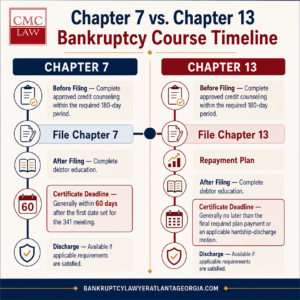
For a Chapter 7 case, the certificate showing completion of debtor education generally must be filed within 60 days after the first date set for the Section 341 meeting of creditors.
For a Chapter 13 case, the applicable certificate generally must be filed no later than the date the debtor makes the final payment required under the Chapter 13 plan, or when a qualifying motion for hardship discharge is filed.
These are federal procedural requirements and should be confirmed for the specific case before publication and before advising a client.
What Happens If You Forget the Debtor Education Course?
Failing to complete the post-filing financial management requirement can prevent a qualifying individual debtor from receiving a discharge.
In a Chapter 7 case, failure to complete the requirement and ensure the appropriate certificate is timely filed may result in the case being closed without a discharge. Reopening a closed case later can involve additional procedure and expense.
The simplest approach is to complete debtor education well before the applicable deadline and confirm that the court has received the required proof.
Bankruptcy Credit Counseling Course for Chapter 7
Credit counseling for Chapter 7 generally follows the same federal pre-filing rule that applies to individual bankruptcy debtors under other chapters. An individual normally must complete approved counseling within the required 180-day pre-filing period.
The course itself does not determine whether you qualify for Chapter 7.
Chapter 7 has separate eligibility considerations, including the means test for many consumer debtors and an analysis of assets and exemptions.
Georgia residents considering liquidation bankruptcy can learn more on CMC Law’s Chapter 7 in Georgia page.
After filing Chapter 7, debtor education becomes another important deadline. The certificate generally must be filed within 60 days after the first date set for the 341 meeting.
Bankruptcy Credit Counseling Course for Chapter 13
The pre-filing requirement also generally applies to individuals filing Chapter 13. The filer must ordinarily receive approved credit counseling within the applicable 180-day period before filing the petition.
Chapter 13 differs from Chapter 7 because it centers on a court-supervised repayment plan. The counseling course does not create that Chapter 13 plan and should not be confused with it.
If credit counseling results in a debt management plan, the Bankruptcy Code may require that plan to be filed with the court.
Learn more about repayment bankruptcy on CMC Law’s Chapter 13 in Georgia page.
The debtor education deadline is also different in Chapter 13. The certificate is generally due no later than the final payment required under the plan, or when an applicable motion for hardship discharge is filed.
Chapter 7 vs. Chapter 13 Course Requirements
Both individual Chapter 7 and Chapter 13 filers generally complete credit counseling before filing and debtor education after filing. The major difference is the deadline for completing and documenting the post-filing financial management requirement.
Do the Credit Counseling Rules Apply to Chapter 11?
The pre-filing credit counseling requirement under Section 109(h) applies to individual debtors rather than being limited to Chapter 7 or Chapter 13.
Post-filing financial management requirements can differ in an individual Chapter 11 case and depend on the circumstances addressed by the Bankruptcy Code and applicable rules.
Business owners and individuals considering reorganization can read more on CMC Law’s Chapter 11 bankruptcy page.
Are There Exceptions to the Pre-Filing Credit Counseling Requirement?
Yes, but the exceptions are limited and should not be assumed to apply simply because someone needs to file quickly.
Federal law contains provisions addressing situations involving a lack of reasonably available approved counseling services in a judicial district and certain exigent circumstances.
For an exigent-circumstances certification, Section 109(h) includes specific conditions. Among other things, the debtor must describe circumstances that merit a waiver, state that counseling was requested from an approved agency but could not be obtained during the specified seven-day period after the request, and submit a certification satisfactory to the court.
This is not a general “emergency filing” exception.
Do not delay required counseling because you expect the court to excuse it later. Anyone facing an urgent foreclosure, repossession, garnishment, lawsuit, or other creditor action should speak with a bankruptcy attorney about timing before filing.
Are There Other Waivers or Exemptions?
Federal bankruptcy law also recognizes narrow circumstances affecting counseling and financial management requirements, including certain situations involving incapacity, disability, or active military duty in a military combat zone.
Whether an individual qualifies depends on the statutory definitions and the facts of the case.
Because these exceptions are narrow, a filer should not skip either course without confirming eligibility for an exemption with counsel.
What Happens If You Take Credit Counseling After Filing Instead of Before?
For most individual debtors, taking ordinary pre-filing counseling only after submitting the bankruptcy petition does not satisfy the standard requirement that counseling occur before filing.
The U.S. Trustee Program specifically warns that if credit counseling is not completed before filing, subject to limited exceptions, the bankruptcy case could be dismissed.
Dismissal can have consequences beyond simply starting over. Depending on the circumstances, filing another bankruptcy case after dismissal can affect how the automatic stay applies in the later case.
If you realize that a course was missed or mistimed, contact your bankruptcy attorney before attempting to fix the problem on your own.
Common Credit Counseling Mistakes to Avoid
A few simple mistakes can create unnecessary problems in an otherwise well-prepared bankruptcy case.
Common mistakes include:
- Taking the course from a provider that is not approved for bankruptcy counseling
- Confusing pre-filing credit counseling with post-filing debtor education
- Completing credit counseling too early
- Filing the bankruptcy petition before completing the required counseling
- Losing or failing to provide the completion certificate
- Assuming one spouse’s course covers both spouses in a joint filing
- Forgetting about debtor education after the bankruptcy case begins
- Waiting until the applicable deadline to deal with the second course
The best way to avoid these problems is to treat both courses as part of your bankruptcy filing checklist rather than optional financial education.
How Credit Counseling Fits Into the Larger Bankruptcy Process
Credit counseling is only one step in preparing a bankruptcy case.
Before filing, you and your attorney may also need to review your debts, income, property, recent financial transactions, tax information, creditor claims, and other documents.
If you are deciding between Chapter 7 and Chapter 13, that decision can affect what happens to your property, how qualifying debts are handled, and whether you will make payments through a repayment plan.
Determine Whether Chapter 7 or Chapter 13 May Fit Your Situation
CMC Law can review your financial circumstances and help you understand which bankruptcy chapter may be appropriate before you move forward.
What Georgia Filers Should Do Before Taking the Course
Before enrolling, confirm where you are in the bankruptcy process.
If your case has not been filed, you are generally looking for the pre-filing credit counseling course.
If your case has already been filed, you may instead need the post-filing debtor education course.
Then verify the provider against the U.S. Trustee Program’s approved list.
If you already have a bankruptcy attorney, ask whether the firm has specific instructions for choosing a provider, submitting your certificate, or completing the course within your filing timeline.
Keeping the process organized can prevent a simple administrative requirement from becoming a problem later.
Frequently Asked Questions About Bankruptcy Credit Counseling
Is a bankruptcy credit counseling course required in Georgia?
Most individuals filing bankruptcy in Georgia must complete approved pre-filing credit counseling within the federally required period before filing, unless a valid exception applies. The requirement comes from federal bankruptcy law rather than a separate Georgia counseling rule.
How long before bankruptcy should I take credit counseling?
The standard rule requires the counseling to occur within the 180-day period ending on the date you file your bankruptcy petition.
Can I take the bankruptcy credit counseling course online?
Yes. Federal law permits qualifying counseling to be provided over the internet or by telephone, as well as through individual or group briefings, provided the applicable requirements are satisfied.
Can I use any credit counseling company?
No. For the bankruptcy requirement, you generally need an organization approved by the U.S. Trustee Program to provide the required service.
Does credit counseling mean I cannot file bankruptcy?
No. Completing credit counseling does not by itself prevent you from filing. The counseling reviews your financial situation and possible alternatives, while your bankruptcy eligibility is determined under separate legal requirements.
Is credit counseling for Chapter 7 different from Chapter 13?
The basic pre-filing counseling requirement generally applies to individual filers under both chapters. The larger bankruptcy processes are different, however, and the post-filing debtor education certificate has different timing rules in Chapter 7 and Chapter 13.
What is the difference between credit counseling and debtor education?
Credit counseling occurs before filing and reviews your financial position and available options. Debtor education is a separate financial management course completed after filing and is generally required before an eligible individual receives a discharge.
What happens if I file bankruptcy before completing credit counseling?
Your case may be subject to dismissal if you did not satisfy the pre-filing requirement and no valid exception applies.
What happens if I forget the second bankruptcy course?
Failing to complete and document required debtor education can prevent entry of a discharge and may result in the case being closed without one.
When is debtor education due in Chapter 7?
The certificate generally must be filed within 60 days after the first date set for the Section 341 meeting of creditors.
When is debtor education due in Chapter 13?
The certificate generally must be filed no later than the final payment required under the Chapter 13 plan or the filing of an applicable motion for hardship discharge.
Do both spouses have to take credit counseling when filing jointly?
Generally, yes. Each individual debtor in a joint bankruptcy case must satisfy the applicable counseling requirement.
Can the bankruptcy court waive credit counseling?
Federal law provides limited exceptions and waivers under specific circumstances, but they should not be treated as routine. Anyone who believes an exception applies should discuss the facts with a bankruptcy attorney before filing.
Get the Timing Right Before Filing Bankruptcy in Georgia
The bankruptcy credit counseling requirement is manageable when it is handled at the right time. For most Georgia consumers, the basic sequence is straightforward: complete approved credit counseling before filing, file the bankruptcy case, then complete the separate debtor education requirement within the deadline that applies to your bankruptcy chapter.
What deserves more careful analysis is the bankruptcy case itself. Chapter 7 and Chapter 13 address debt in different ways, and the right option depends on your income, assets, debts, payment problems, and financial goals.
Determine Whether Chapter 7 or Chapter 13 May Fit Your Situation
CMC Law helps individuals and families throughout the Atlanta area understand their bankruptcy options and prepare for the filing process.